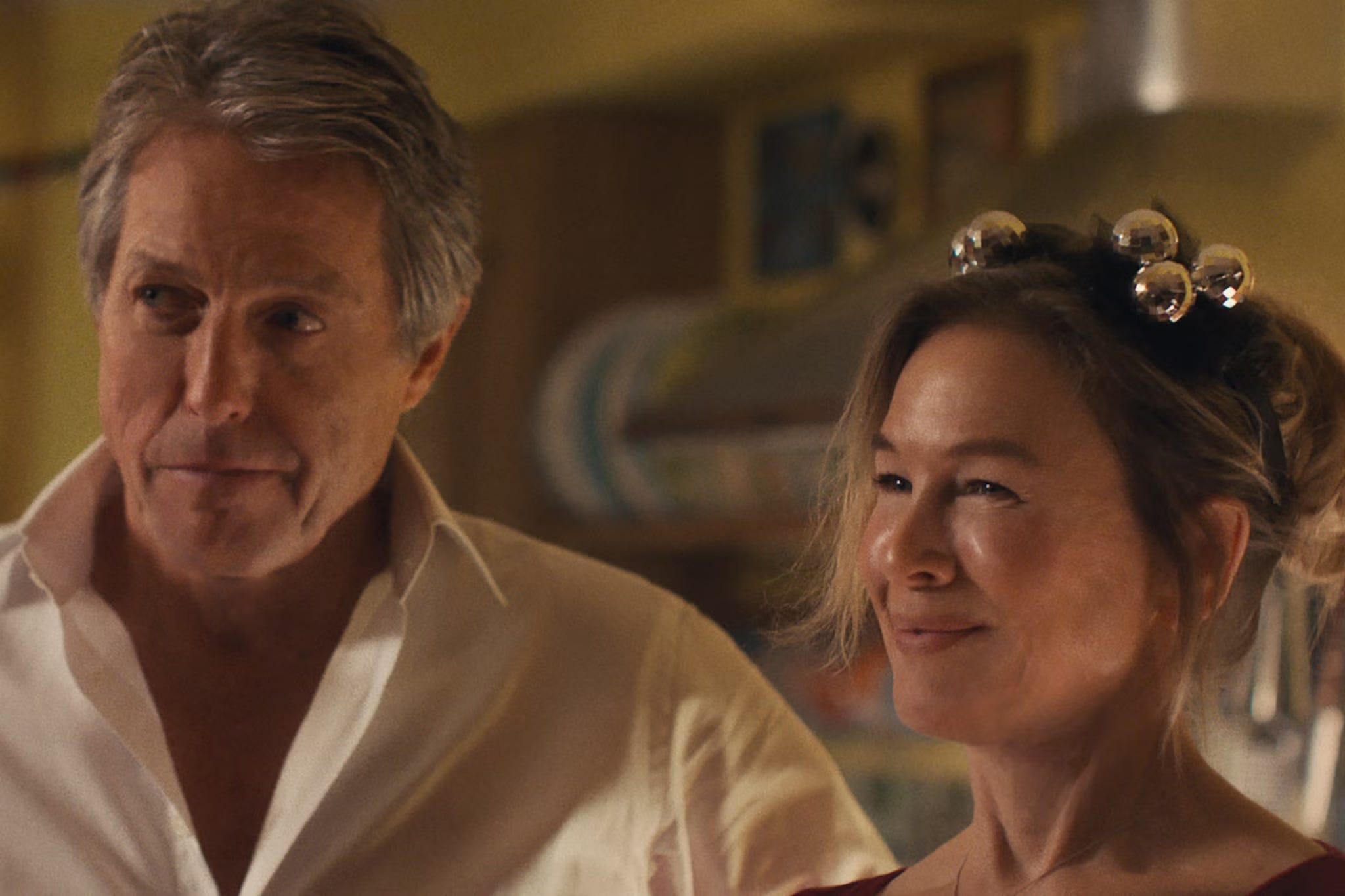
The new Bridget Jones movie is…shockingly good?
Now here’s a rom-com with IDEAS!
All I remember feeling after the (one and only) time I ever watched Bridget Jones’s Diary was an attraction to Hugh Grant as a convincingly devastating cad, plus a vague annoyance with Renée Zellweger’s twee woe-is-me schtick. The appeal of the supposedly iconic 2001 rom-com was otherwise mostly lost on me, particularly as a non-Brit unfamiliar with Helen Fielding’s original column/book series on which the film franchise is based on; personally, I preferred my single girl mania served à la American Bradshaw.
So it didn’t take much for me to skip—or rather, remain entirely oblivious about the existence of—the last two Bridget Jones movies, Bridget Jones: The Edge of Reason (2004) and Bridget Jones’s Baby (2016). And I would have let the arrival of this year’s Bridget Jones: Mad About a Boy (now streaming on…Peacock?) dissolve totally in some outer corona of awareness were it not for some snippet of some review I must have read at some point that lodged itself in memory. And lo, confronted with a snowy Valentine’s weekend (and a slightly hunted feeling from encountering all the SNL 50th anniversary content on every screen I looked at), I loaded up the fourth Bridget Jones with zero expectations. Twenty minutes in, I couldn’t stop crying.

I am going to get into spoilers in the next paragraph, but can I just tell you right now that BJ4 (lol) was not only good—it was shockingly good?? And poignant. And tender. And funny! And heartbreaking. And transcendent? And honestly…oddly realistic! At one point, I texted myself, “Now this is a rom-com with IDEAS!!!!” To be completely serious, I don’t think it’s overly dramatic to declare that BJ4 belongs in the pantheon of great rom-coms, next to The Notebook and Love, Actually. I haven’t been able to stop thinking about it or asking people if they’ve watched it ever since.
Part of this certainly comes from (and here the spoilers begin) the film’s treatment of grief. Of course, the revelation that the ultimate form of love = grief is not exactly a BJ4-exclusive insight, but I loved that the death of Colin Firth’s Mark Darcy was more than just a plot device to free our heroine up for fresh romantic hijinks (looking at you, And Just Like That!). Instead, the film dignified Bridget’s grief as real and enduring, and it treated the issue of how one should mourn a loved one over a lifetime as its central question. Can you blame me for weeping?
Even better, though, was how BJ4 insisted that, nevertheless, this part of Bridget’s life is no less joyful than her youth, if not more so. It was a thrill to see how the character’s slightly delusional girlishness, which I found so off-putting in the original movie, bloom into something warmer, more radiant as 50-something Bridget as she tries so hard to do right by her kids and herself. I loved the way the movie peopled her life not only with a couple of yummy romantic interests, but especially with a social circle that’s the actual stuff of fantasies: thoughtful children, decades-old friendships, a brilliant young nanny, deadly loyal co-workers, and an endearing ex who turns out to be a decently reliable with childcare (more on that in a sec). Honestly, I have yet to see a rom-com do a better job of portraying the actual fullness of a life well-lived (the fact that it takes place in a spacious Hampstead house doesn’t hurt!). This morning, I told my therapist that BJ4 is the only movie I’ve seen in recent memory that makes me actually excited about middle age: To think of all the people you’d know how to love by then, and all the people who’d love you back.
Which brings me back to Hugh Grant, perhaps as ever. While Leo Woodall lives up to the “toy-boy” yumminess as the sub-titular role (yet even he resists a simple 2D fuccboi characterization) and Chiwetel Ejiofor possibly out-Darcys even Colin Firth’s Darcy with respect to exemplary male British sternness, there’s a strong case to be made that the Bridget Jones franchise’s central relationship is still the one between our heroine and that first dashing cad, Daniel Cleaver. For most of the movie, I assumed that Daniel’s character has been kept around for fan service and continuity’s sake; it was fun to learn that in the BJ-verse (lol sorry I’m almost done), Daniel is still up to his usual tricks romantically, but he’s also since become a great friend and babysitter (assuming you’re okay with him teaching your kids how to make a proper drink).
It’s a happily-ever-after for Bridget and Daniel that is as wholesome as it is aspirational: no one really changes, but everyone does grow up. At the end of the movie, shortly after experiencing a C-plot mid-life crisis of his own, Daniel invites his teenage son, with whom Bridget encouraged he finally begin a relationship with, to a party of hers. Casually but confidently, Daniel introduces Bridget to his son as “your hostess, and one of the great loves of your father’s life.”
My God. This is what killed me in the end, and what I think actually makes Bridget Jones: Mad About a Boy a true romantic. If all of the most interesting rom-coms are supposed to teach us something about love—that it’s everywhere, according to Love, Actually; that it never ends, per The Notebook—then it is with Bridget Jones: Mad About a Boy where we learn, rather, that even true love may not last. But it does always transform us.


As a huge BJ1 (lol) fan I was skeptical. But BJ4 was the perfect mix of true to the original vibe/cast yet somehow not ever feeling glib re: death, grief, motherhood, aging. Rom coms are mostly disappointing now so what a TREAT. This kind of felt like a salve after The Substance and Babygirl awards frenzy that made older women seem honestly kind of sad and insane.
Actual text to my bestie whilst watching it: ‘ARGH I’m halfway through the new Bridget jones and have cried 3 times? Fucking hormones. Or it’s good? I don’t even know!’
It was great, actually 😊