

Come with me as I nitpick the internet
What’s up with Mediagazer’s X strategy?

Woke up with a bit of a cold (not to be French but it’s all this AC!), however it’s already clearing up so in god I will trust to make it to my The Odyssey IMAX 70mm tomorrow…
Speaking of which, this interview Chris Stanton did with a retired IMAX projectionist for Vulture is fantastic. When I was a kid, I definitely believed that there was a real person sitting way up behind us running the movie/watching the backs of our heads for fun, but for some reason into adulthood I began to assume that was not actually a thing. Turns out, yes (at least for film films), though the working conditions sound pretty wild: 12-hour shifts (at least to meet The Odyssey demand), there used to be a very closed union, you get put on jobs in different places all over the country, you have to stay hyperaware of dust and dirt on the reels the whole time. It never occurred to me that in this position one would have to watch the same movie over and over maybe for months; does that not drive people crazy? Is there such thing as projectionist psychosis? Let’s call this guy back, I have many more questions.
One must believe that Margaret Sullivan and the entire lineage of NYT public editors walked so that Daniel D’Addario (who currently my money’s on for the spiciest media X follow these days) could run…
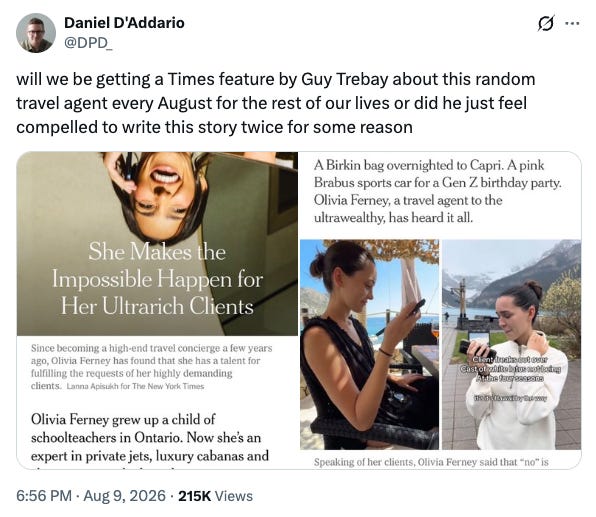
While we’re on the topic of X, here is some truly small potatoes — fingerling potatoes, really (it is mid-Aug for chrissake) — that I noticed recently: Since April, Mediagazer has switched to a pretty strange-seeming posting strategy, in that they will tweet the headlines of the top stories they’ve aggregated, but won’t include the link to the actual story (they do tag the writer and name the publication, though).
They’re doing this apparently for reasons related to reach (citing this study, though keep in mind back when people were @-ing the Pope about how to post links in the follow-up tweet for maximum engagement, Nikita Bier from X stepped in and said that was a myth?), plus the increased cost of whatever API they use to post their links on X. Okay, sure. To be fair, I really cannot imagine more than like five people caring about this lol, but it’s very bizarre to me because it calls into question the whole premise of Mediagazer in the first place as an otherwise solid links aggregator that isn’t purely automated. Like I do not think you can aggregate links on your site and then post about them back out on a social platform, like X, and expect people to 1) Read that post (containing someone else’s headline and story), 2) come to Mediagazer.com for the actual link, and then 3) Click on the link from there to be taken to the actual story on the actual outlet’s website? Obviously we at Deez Links have an enormously vested interest in believing that artisanal curation of links is a valuable service, but perhaps this exact strategy is… not the most efficient use of anyone’s time? Have you guys considered maybe doing a newsletter………actually wait….. forget I said that….
That New York mag story about the city’s thriving SWANA (Southwest Asia and North Africa) community is such a smart idea, but even before diving into it, I love this juxtaposition posted by the @oldnymag IG account between the new issue and an issue from 1975 with a cover story (and mega-cringe illo — what is this, pre-2019 The Atlantic?) asking “Arabs in New York: Can They Cut It In the Big Apple”? Now there’s a story told in a single post!
Notable Quotables (dudes in the news edition):
“...the dark prince of kitchen gonzo has become for the present generation what James Dean and Jim Morrison were in earlier times, the essence of acceptable rebellion” is quite good for the millionth thing you and I have probably read about Anthony Bourdain, or more accurately, Bourdainiana as illuminated by Aaron Timms in NYT Mag. Interesting to see how our views of the man and his influence now play through a specifically 2026 filter: “A sinner and a saint, Bourdain married aesthetics to ethics in a way that few in popular culture had managed before, and no one has managed since. And he did it all, it seemed at least, while respecting the highest calling of the consumer economy: He enjoyed himself.”
“The 62-year-old has lived a singular life. He resides in the top 1 percent of the top 1 percent of all movie stars, not only today but ever, as measured by any metric you like, including intrigue. What does he have to say about all of it?” <- Unfortunately this is quite possibly the most bizarre, garbled dek I’ve read, possibly designed to distract you, the reader, from having to formulate an opinion on the general Brad Pitt reputation-laundering-via-glossy situation?
“Although there are more than 132 million registered accounts on Wikipedia, a study found that 1% of these users are responsible for roughly 80% of the site’s content.” (I re-styled the numbers here so a normal person and not just a New Yorker copy editor can read them) — have yourself a very pleasant time learning about the Wikipedia super editor Steven Pruitt in Carson Griffith’s piece for The New Yorker